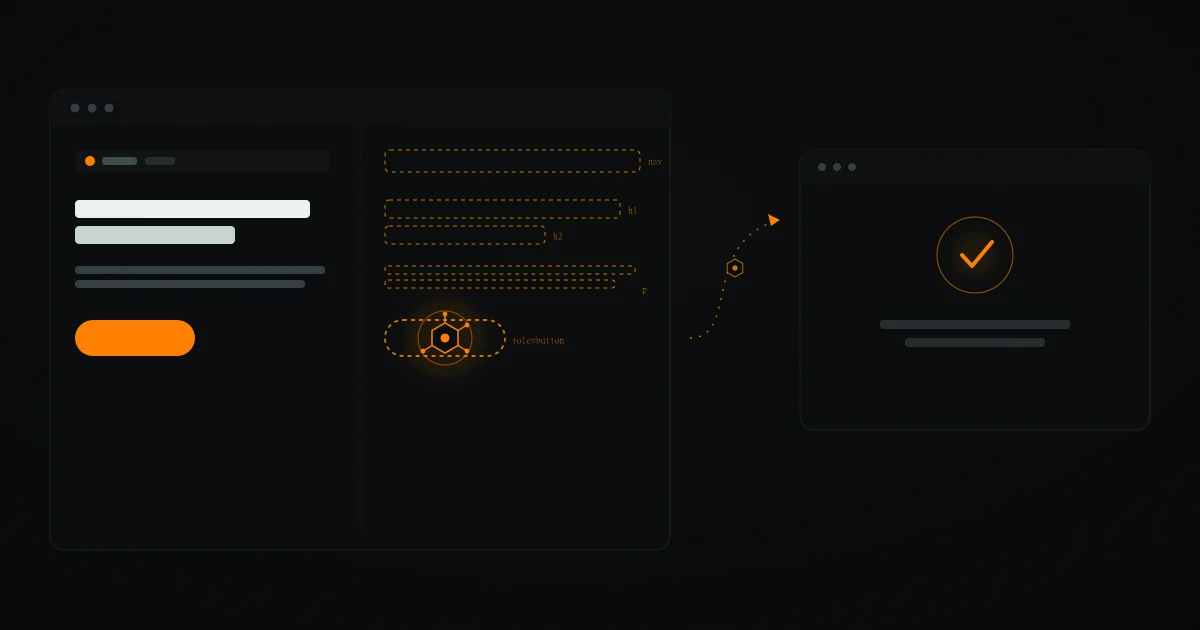
A growing number of visitors who arrive at a website are no longer humans clicking — they are AI agents who navigate, fill out forms, and make decisions on a user's behalf. This phenomenon has a name: agentic navigation. And it's quietly changing the rules of what a "well-made" site means.
What is agentic navigation?
Assistants like Claude (via "computer use"), ChatGPT Operator or Perplexity's search agents can now open a browser, browse a page, identify a button, fill out a field and validate an action - exactly like a human user would do, but without appearing to do so. A visitor can today ask their AI assistant to “make an appointment with this service provider” or to “compare the prices of these three agencies”, and it is the agent who will browse your site for them.
Concretely, this means that your site now has two audiences to satisfy: humans, and the agents who act on their behalf. A site optimized only for the human eye may very well be invisible, or worse, incomprehensible to an agent — and therefore silently left out of a decision-making journey in which you will never know you participated.
The direct link with accessibility: it’s not a coincidence
Here's what's not very intuitive at first glance: a site accessible to people with disabilities is, almost mechanically, a site readable by AI agents. Both rely on the same technical basis: a clear semantic HTML structure, consistent ARIA roles, explicit labels on buttons and form fields.
This is not a coincidence. A screen reader and an AI agent basically do the same thing: they don't "see" the page as a visual rendering, they read it via its accessibility tree (the tree of roles, labels and relationships that the browser builds from the DOM). If this tree is poorly formed, both audiences fail to properly interact with your page — for different reasons, but with the same result: abandonment.
A concrete example
On a recent project, an accessibility audit reported that a carousel built with tags carrying a role="group" role was failing a basic ARIA test: that role is simply not allowed on a list item. A human never notices this kind of detail — visually, everything works. But an agent that analyzes the structure of the page to understand “what is this element, what is it for, can I interact with it” may get stuck or misinterpret the component. The fix — replacing the list tags with simple generic containers with the correct roles — fixed the issue without visually changing anything. This is typically the kind of detail invisible to a human, but decisive to an agent.
What breaks agentic navigation
- Buttons without accessible label: a single icon, without
aria-label, means nothing to an agent who must guess its function - Poorly structured forms: fields without an associated
, or groups of fields withoutfieldset/legend, make autofill unreliable - Content generated only on click, without accessible state: if information only exists in the DOM after a complex interaction (hover, drag and drop), an agent who does not exactly reproduce this gesture never finds it
- Inconsistent or incorrect ARIA roles: As in the example above, an incorrectly used role can cause the interpretation of an entire component to fail
- Critical actions only in non-standard JavaScript: a “Validate” button which does not trigger a real interpretable click event, but a proprietary gesture, complicates automation
A concrete scenario to understand the issue
Imagine a craftsman who sells custom kitchens. A prospect asks his AI assistant: “find me three kitchen designers near Toulouse and make a quote appointment with the one who has the best reviews.” The agent will browse several sites, compare the opinions displayed, then try to fill out the appointment form for the selected site.
On a well-structured site, the agent unambiguously identifies the form, its fields (name, telephone, desired date), the validation button, and confirms the appointment in a few seconds. On a site where the form relies on non-standard elements, without clear labels, or where validation depends on an unusual interaction (a custom slider without an ARIA role, for example), the agent silently fails — or worse, incorrectly fills out a field without anyone noticing before the prospect is surprised to never get a call back. In both cases, the craftsman loses a customer without ever knowing why: no line in the statistics will say "an AI agent abandoned on your form".
AEO: the natural extension of SEO
We are starting to see the term AEO (Agent Engine Optimization) emerge, echoing classic SEO. The idea: in the same way that we optimize a site so that Google understands and ranks it, we must now optimize it so that an AI agent can understand it and act on it correctly. The two disciplines largely overlap - a well-structured site semantically serves both objectives at the same time - but the AEO adds an additional requirement: the page must remain usable from start to finish by an actor who does not "see" the visual rendering, only the logical structure.
Unlike SEO, there is not yet a standardized measurement tool for AEO, nor a public ranking equivalent to Google positions. But the technical bases that prepare for this have already been known and documented for a long time: these are, almost word for word, the criteria of the WCAG standard (Web Content Accessibility Guidelines), initially designed for assistive technologies and which today also happens to be the best guide available for preparing a site for agentic navigation.
This convergence is not anecdotal for a company that must prioritize its investments: instead of treating “accessibility” and “AI compatibility” as two separate projects, a single technical effort — WCAG compliance — meets both requirements at the same time. This is one of the rare cases where a regulatory obligation (digital accessibility is gradually becoming mandatory in several sectors) and an emerging business opportunity point in exactly the same direction.
A practical checklist to prepare your site
- Use native semantic HTML before resorting to ARIA roles — a real
is better than awithrole="button"- Give an accessible label to each interactive element:
aria-label, visible text, or associationfor form fields- Check the consistency of ARIA roles with an audit tool (Lighthouse, DevTools axis) — an unauthorized role on an element is a silent but real error
- Avoid complex non-standard interactions for essential actions (purchase, contact, reservation) — keep at least one path accessible via simple click and keyboard
- Test your site with a keyboard alone, without a mouse: if you can't reach and activate every important element with Tab and Enter, neither a screen reader nor an AI agent will reliably get there
- Structure your forms properly: each field with its label, the required fields clearly identified, error messages associated with the correct field
Why act now rather than later
These recommendations have existed for years under the name of digital accessibility — and they were already, in themselves, a good reason to act: progressive legal obligation in several countries, market for people with disabilities too often ignored, brand image. Agentic navigation adds an additional business reason: a site that fails to be understood by an AI agent loses business opportunities without any alerts being triggered — no visible errors, no visitors complaining, just an action that silently fails elsewhere, in a conversation between a customer and their assistant.
Unlike a complete overhaul, bringing a site up to accessibility and semantic structure standards is a progressive project: you can start with the most strategic pages and paths (contact, quote, appointment making) without rebuilding everything at once. It is also, very concretely, the kind of work that a technical audit allows you to quickly identify.
- Give an accessible label to each interactive element: